EMNLP 2026 · Industry Track · 2026
OntoForm: Ontology-Grounded Semantic Data Generation for Enterprise Document Understanding
Openstream AI
A semantic-first framework for generating privacy-preserving enterprise form packets with ontology-grounded extraction, question answering, and validation signals.
- Document understanding
- Synthetic data
- Ontology grounding
Research summary
Why enterprise forms are hard
Enterprise forms are not collections of independent fields. A submission can describe the same applicant, location, exposure, or coverage across recurring sections and several related documents. Those values must agree even when labels and layouts change.
Authentic training data is difficult to obtain because forms contain sensitive information, require expensive annotation, and vary across organisations. Existing synthetic pipelines can make plausible pages, but independently filled fields may still contradict one another.
A semantic-first pipeline
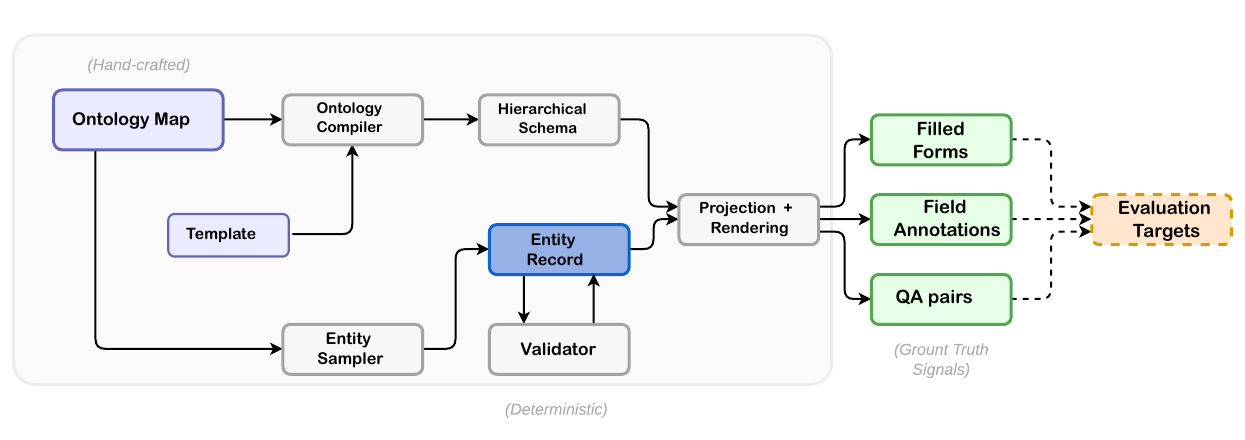
OntoForm begins with an ontology map and a document template. The ontology compiler turns stable domain concepts into a hierarchical schema; the entity sampler creates a latent record; a deterministic validator checks its constraints; and the renderer projects that record into one or more forms. Because the semantic record is shared, related documents inherit the same underlying facts.
𝒞 contains concept classes, 𝒫 their properties, ℛ semantic relations, and 𝒦 the constraints, dependencies, and sampling rules. The representation is intentionally lightweight and independent of page layout.
The compiler binds ontology paths to template fields, page indices, value types, and bounding boxes. Sampling then follows the dependency graph rather than filling fields independently:
z is the complete entity record, s is an optional business scenario, and pa(v) contains the declared parents of field v. In plain language, every dependent value is sampled only after the facts it relies on are known.
A candidate record is accepted only when the validator confirms its types, required fields, cardinalities, temporal rules, and cross-document invariants. When possible, OntoForm resamples only the invalid subtree instead of discarding the whole record.
Traceable supervision, not just plausible pages
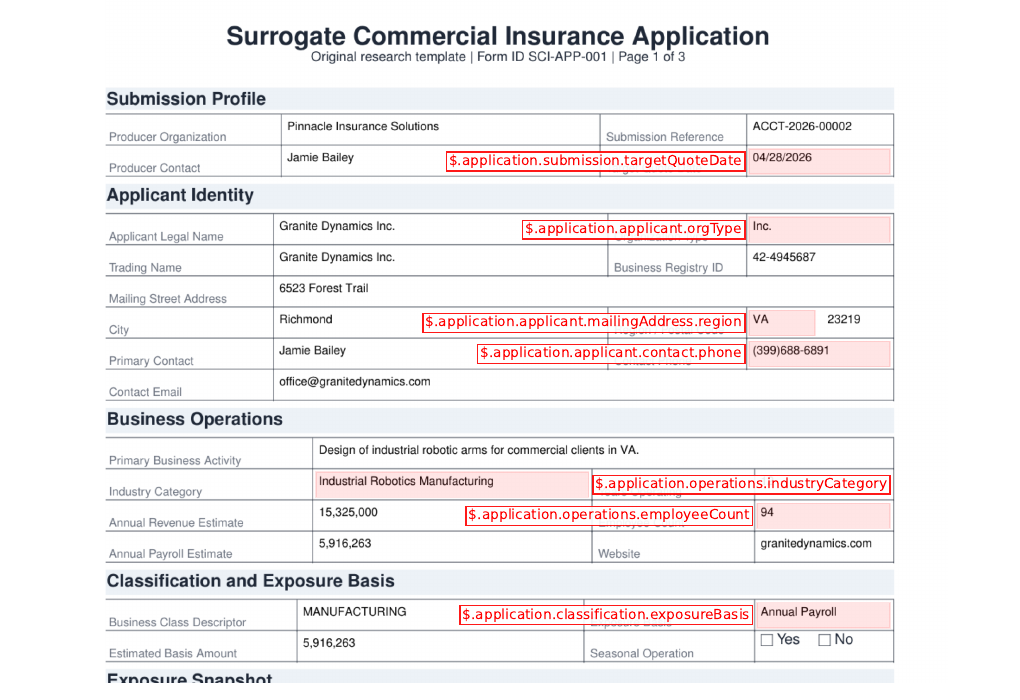
Every rendered value can be traced to an ontology path, sampling rule, and template location. That single source record produces several aligned supervision signals:
Filled forms
Template-consistent documents generated without private production records.
Field annotations
Exact values, ontology paths, page locations, and pixel-level boxes.
Grounded QA
Questions and answers tied to visible evidence in the rendered document.
Validation metadata
Machine-checkable evidence for types, dependencies, and cross-form consistency.
Evaluation at a glance
The controlled insurance study covers three surrogate form types: Commercial Application, General Liability, and Business Auto. Entity-level splits keep the same sampled business profile from appearing in both training and test sets.
| Question | Comparison | Measured gain |
|---|---|---|
| Does synthetic supervision help grounded QA? | ROUGE-L: 53.1 → 97.2 | +44.1 |
| Does it improve ontology-keyed extraction? | F1: 87.36 → 92.35 | +4.99 |
| Does ontology guidance transfer to a held-out form? | F1: 60.90 → 96.95 | +36.05 |
| Can the model recover concepts absent from training? | F1: 53.92 → 96.59 | +42.67 |
| Can it reason across a multi-form packet? | Exact reasoning: 18.33 → 52.50 | +34.17 |
Scores are percentages or percentage-point gains. Comparisons follow the matched conditions reported in Tables 2–6 of the paper.
What ontology grounding changes
The strongest gains appear when the layout or semantic inventory changes. On a held-out Business Auto form, ontology guidance adds 36.05 F1 points across all fields and 42.67 points on concepts that never appear in the training forms.
The same pattern holds for two unseen surrogate lines of business. Canonical path-value F1 rises from 4.1 to 91.4 for Workers’ Compensation and from 5.2 to 80.2 for Commercial Property. Hallucination falls from 95.1% to 1.0% and from 93.5% to 0.1%, respectively. These experiments remain inside the controlled synthetic pipeline, but they isolate the benefit of stable semantic paths when surface forms change.
Scope and limitations
- The study uses digitally rendered, template-consistent surrogate insurance forms; it does not establish transfer to authentic enterprise documents.
- The evaluation does not yet cover handwriting, stamps, skew, OCR errors, low-resolution scans, missing fields, or continuously evolving layouts.
- OntoForm uses a lightweight task ontology rather than full OWL or description-logic reasoning, and authoring its maps, validators, and bindings requires domain expertise.
- Strong synthetic-data results are not evidence that an automated system is safe for consequential insurance decisions. Production use still requires human review, shift monitoring, and fairness evaluation.
Takeaway
OntoForm reframes enterprise forms as layout-specific views of a shared semantic entity. That shift makes it possible to generate scalable, privacy-preserving supervision while retaining the cross-field and cross-document consistency required for extraction, grounded question answering, and multi-form reasoning.
Use this work
Citation
Kunananthaseelan, N., Kane, B., Jain, S., Ghorbanali, M., Shiri, F., Tumuluri, R., & Haffari, G. (2026). OntoForm: Ontology-Grounded Semantic Data Generation for Enterprise Document Understanding. EMNLP 2026 Industry Track.
@inproceedings{kunananthaseelan2026ontoform,
  title     = {OntoForm: Ontology-Grounded Semantic Data Generation for Enterprise Document Understanding},
  author    = {Kunananthaseelan, Nilakshan and Kane, Benjamin and Jain, Siddharth and Ghorbanali, Mahsa and Shiri, Fatemeh and Tumuluri, Raj and Haffari, Gholamreza},
  booktitle = {Proceedings of the 2026 Conference on Empirical Methods in Natural Language Processing: Industry Track},
  year      = {2026}
}