AAAI Conference on Artificial Intelligence · 2024
LaViP: Language-Grounded Visual Prompting
A parameter-efficient way to adapt vision-language models by grounding visual prompts in language, including black-box settings.
- Visual prompting
- Vision-language models
- Model adaptation
Research summary
Abstract
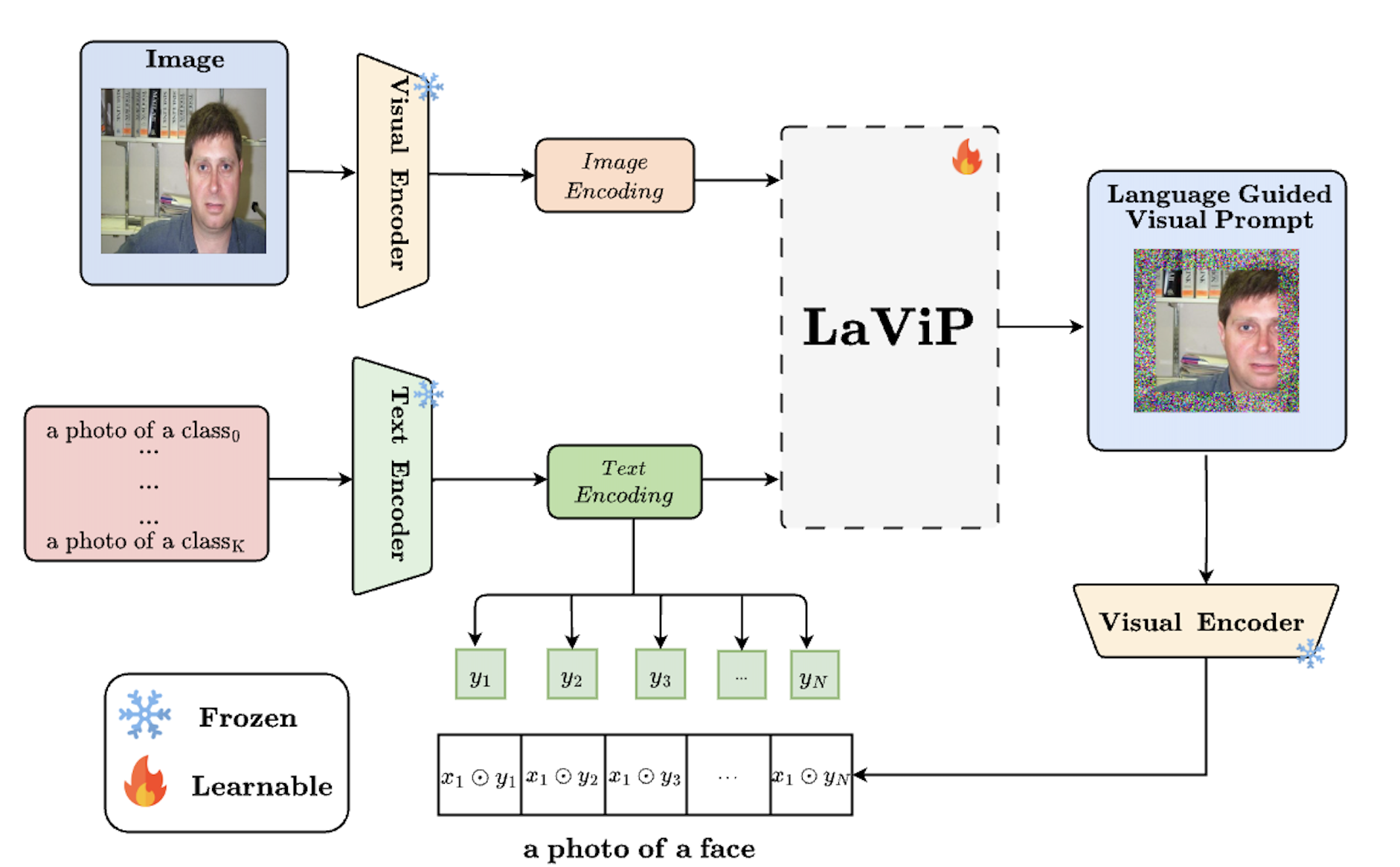
LaViP adapts the visual encoder of a vision-language model by learning prompts at the image input. Language provides semantic grounding for those prompts, helping the model reuse its pretrained representation without modifying or extending the encoder’s parameters.
Core idea
Traditional visual prompting learns an input transformation from visual examples alone. LaViP incorporates class-language information when generating the prompt, connecting the downstream task to the semantic structure already present in the vision-language model.
Capabilities
Because adaptation happens at the input, LaViP can work when the model’s internal parameters are frozen or inaccessible. The method is evaluated in few-shot adaptation, base-to-novel generalisation, and transfer-learning settings across datasets including EuroSAT, UCF101, DTD, and CLEVR.
Why it matters
Language grounding improves the accuracy and speed of visual prompt learning while retaining the efficiency and black-box compatibility of model reprogramming.
Use this work
Citation
Kunananthaseelan, N., Zhang, J., & Harandi, M. (2024). LaViP: Language-Grounded Visual Prompting. Proceedings of the AAAI Conference on Artificial Intelligence, 38(3), 2840–2848.
@inproceedings{kunananthaseelan2024lavip,
  title     = {LaViP: Language-Grounded Visual Prompting},
  author    = {Kunananthaseelan, Nilakshan and Zhang, Jing and Harandi, Mehrtash},
  booktitle = {Proceedings of the AAAI Conference on Artificial Intelligence},
  volume    = {38},
  number    = {3},
  pages     = {2840--2848},
  year      = {2024},
  doi       = {10.1609/aaai.v38i3.28064}
}